


31. July 2025

Press
31. July 2025
Munich/Norderney, July 31, 2025 – A strong impetus for sustainable shipping and regional energy independence: AG Reederei Norden-Frisia is setting another example for the maritime mobility and energy transition. With the integration of two innovative battery storage solutions from STABL Energy, the long-established company is expanding its energy concept and taking a major step towards climate-neutral island supply.
The new energy storage systems in 20-foot container format, equipped with a total of 1,849 kWh of usable capacity and an output of 608 kW, fulfil a dual mission, as they optimise the use of self-generated solar power and at the same time reduce the load on the power grid when charging the new e-catamaran FRISIA E-1, the first fully electric seagoing vessel in German liner service.
Second-life battery modules from electric vehicles are used, which can be reused directly and efficiently thanks to STABL’s innovative multilevel inverter technology. The shipping company thus combines ecological recycling management with a strategic increase in its energy self-sufficiency. AG Reederei Norden-Frisia, with its twelve ferries, passenger and cargo ships, has been performing the tasks of a classic island supplier for over 150 years, mainly serving the islands of Norderney and Juist from Norddeich with a year-round scheduled ferry service.

“The East Frisian Wadden Sea is our cruising area and is specially protected as a national park and UNESCO World Heritage Site. Sustainability is therefore not a side issue for us, but the core of our business. With the battery storage systems from STABL Energy, we can not only further improve our carbon footprint, but also significantly reduce the ecological footprint of electromobility through the sensible secondary use of e-car batteries,” explains Norden-Frisia CEO Carl-Ulfert Stegmann.
The use of storage systems is part of a larger transformation process. With the aim of creating a closed cycle of electricity production and consumption, Frisia began equipping suitable roof surfaces with PV collectors at an early stage. Since March 2024, the shipping company has been operating a 1.6 MW photovoltaic charging park with 600 covered parking spaces and 242 charging points. A further 750 kW free-standing PV area is being planned. In March 2025, the FRISIA E-1, the first all-electric ocean-going vessel under the German flag, will also be in regular service.
This CO2-free catamaran has a capacity of 150 passengers and has been calling at the island of Norderney three times a day since then. For passengers on the FRISIA E-1, the journey time to Norderney has been reduced to 30 minutes.
“The Reederei Norden-Frisia impressively demonstrates how emission-free mobility, local energy generation and battery storage can work together intelligently. We are delighted to be part of this pioneering project with our technology and to be helping to shape the maritime energy transition together,” says Martin Sprehe, Co-Founder & Managing Director of STABL Energy.

AG Reederei Norden-Frisia was founded in the late 19th century under the name “Frisia” as a pure shipping company. Since then, it has developed into a group of companies offering a wide range of island supply services. Today, the group employs a total of around 300 people. Around 200 of these are employed by the actual AG Reederei Norden-Frisia as the core company.
The task of “Frisia” was previously that of a classic island supplier and is now changing into a demand-oriented mobility provider. With twelve ferries, passenger and cargo ships, it mainly serves the islands of Norderney and Juist from Norddeich on a year-round scheduled service.
STABL Energy is a provider of sustainable and reliable battery storage systems with the aim of increasing the use of renewable energy and contributing to grid stabilization. Its easy-to-integrate inverter technology sets a new standard for battery storage systems in terms of design, safety, reliability, cost efficiency and handling. Thanks to the special design, the individual battery modules are interconnected independently and dynamically. This guarantees almost complete availability and modules in different states can be installed in one battery storage system.
Picture credits: Janis Meyer / STABL Energy GmbH
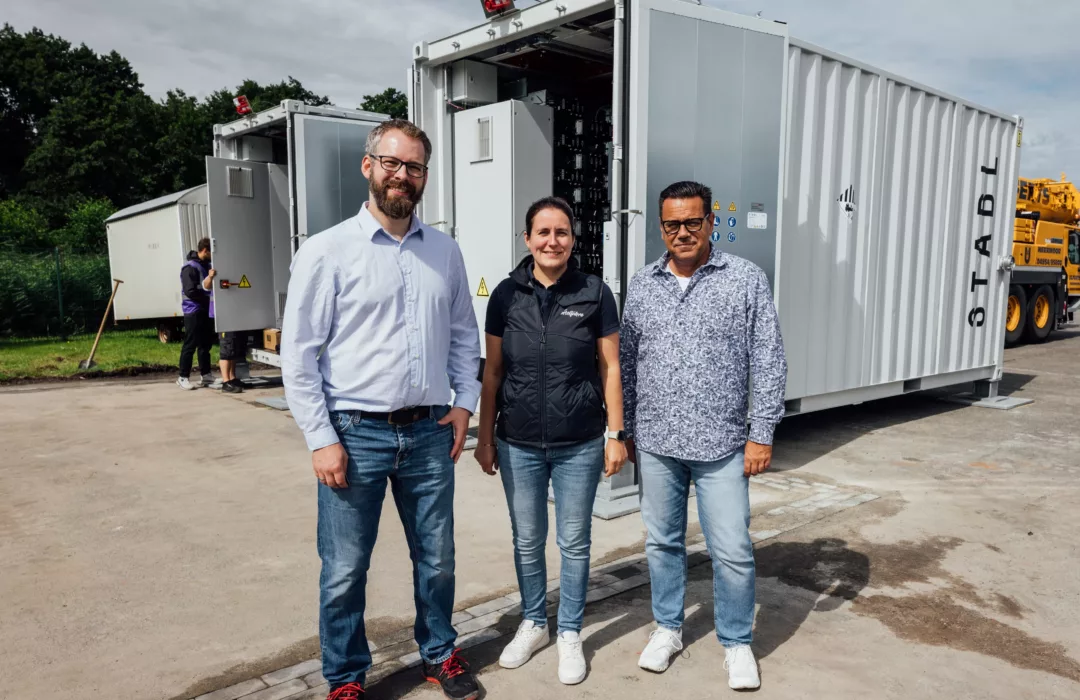
Caption Group photo:
Successful delivery and installation of battery storage systems.
V.l.n.r.: Martin Sprehe, STABL Energy, Maraike Pommer und Olaf Weddermann, beide Frisia.

23. March 2026
Smart Energy Use at Mantos International Food

23. October 2025
Erdenwerk Gregor Ziegler GmbH Optimises Energy Efficiency
31. July 2025
Reederei Norden-Frisia Realises Emission-free Island Mobility
Navigation
© 2026 STABL Energy GmbH